

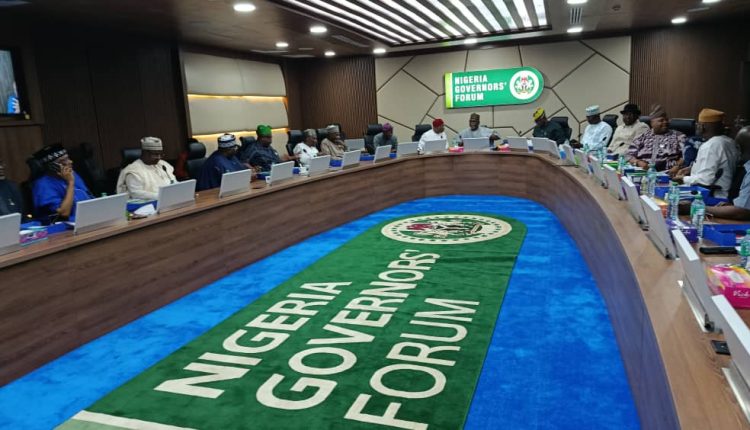
A renewed clash has emerged between the Nigerian National Petroleum Company Limited and Periscope Consulting, the audit firm hired by the Nigeria Governors’ Forum to examine an alleged under remittance of oil revenue totalling $42.37bn (about N12.91tn) to the Federation Account between 2011 and 2017.
The dispute, revived by fresh submissions from both sides, has forced the Federation Account Allocation Committee to mandate a joint reconciliation session to determine the true state of remittances and resolve the long-running impasse.
This was disclosed in the Federation Account Allocation Committee’s post-mortem review for November 2025, which detailed fresh exchanges between both parties over the alleged unremitted fund. The document was obtained by our correspondent on Tuesday.
Recall that in October, The PUNCH reported an extension of the ongoing probe and reconciliation of payments made by revenue-generating agencies, including the Nigerian National Petroleum Company Limited, to December 2024, following unresolved discrepancies in remittances. It also examined allegations that NNPC Limited failed to remit $42.37bn (about N12.9tn) in oil revenue to the Federation Account during the 2011–2017 period.
The review follows findings by Periscope Consulting, a firm engaged by the Nigeria Governors’ Forum, which had earlier accused the state oil company of withholding crude oil proceeds and other statutory revenues due to the Federation Account during the period.
But in the new document, the FAAC Sub-Committee confirmed that NNPCL had formally rejected the audit findings, insisting that no outstanding revenue is owed to the Federation Account for the period under review. The national oil company maintained that all crude oil proceeds and associated earnings were fully accounted for, disputing Periscope’s claims of significant underpayment.
But Periscope Consulting flatly disagreed with NNPC Limited’s defence, maintaining that its audit uncovered substantial gaps in remittances and that the alleged $42.37bn shortfall remained unresolved.
The report read, “UPDATE ON NNPC’S ALLEGED UNDER REMITTANCES TO FEDERATION ACCOUNT OF $42,373,896,555.00.
“NNPC Limited submitted their response regarding $42,373,896,555.00 under remittance to the Federation Account as contained in the report of Periscope Consulting. Recall that Periscope Consulting was the Consultant engaged by the Governors’ Forum to examine NNPC Limited under remittance to the Federation Account.
“NNPC Limited responded that all revenues due to the Federation have been properly accounted for and no outstanding amounts for the period under review.”
This disagreement has pushed both sides into a stalemate, with the consultants accusing the oil company of providing explanations that do not reconcile with the audited data.
The FAAC sub-committee, noting the conflicting positions, directed that NNPCL and Periscope Consulting must meet jointly to harmonise records and “close out” the matter. It added that the reconciliation process remains ongoing.
“Responding, Periscope Consulting disagreed with NNPCL’s position; hence, the Sub-Committee directed that there should be a joint meeting with the two parties to close out on the issue. This assignment is work in progress,” it added.
The controversy marks the latest chapter in a prolonged dispute between state governments and the national oil company over transparency in oil revenue flows. In February 2025, FAAC suspended its monthly meeting due to a dispute between state governments and NNPC Limited over outstanding remittances.
The dispute over an estimated N1.7tn in revenues raised concerns over potential delays in revenue disbursement to states, which rely on FAAC allocations for budgetary commitments.
The Governors’ Forum commissioned Periscope Consulting amid complaints that NNPCL’s remittance practices, including handling of crude sales, domestic allocation, subsidy deductions, and JV cash calls, were opaque and inconsistent with expected inflows.
With oil receipts forming the backbone of FAAC disbursements, any alleged shortfall threatens state and local government finances, already strained by rising inflation and shrinking real revenue.
NNPC Limited, now operating as a limited liability company under the Petroleum Industry Act, has consistently defended its processes, claiming improved accountability and asserting that independent audits often misinterpret commercial and regulatory procedures governing its operations.
The latest face-off underscores deepening mistrust on both sides and places renewed pressure on FAAC to reconcile the books in the interest of fiscal stability.
Commenting on the issue, renowned Professor Emeritus of Petroleum Economics, Wumi Iledare, said the alleged $42.37bn under-remittance recorded between 2011 and 2017 reflects long-standing flaws in Nigeria’s pre–Petroleum Industry Act regime.
According to him, the former Nigerian National Petroleum Corporation operated with overlapping roles that made revenue reconciliation cumbersome and frequently disputed. Iledare described the controversy as a “legacy problem,” stressing that similar discrepancies can be avoided only through disciplined implementation of the PIA, real-time monitoring, and continuous independent audits.
He added that with transparent data and clear fiscal rules, future remittance disputes should not recur. Speaking in an interview, he said, “The alleged $42.37bn under-remittance from 2011–2017 simply reflects the weaknesses of the old pre-PIA system. The former NNPC had overlapping roles that made revenue reconciliation difficult and prone to disputes.
“The lesson is clear: fully implement the PIA, strengthen real-time monitoring, and enforce continuous independent audits. With transparent data and clear rules, issues like this should not arise again. It is a legacy problem. The future depends on disciplined implementation of the PIA.”
The Post-Mortem Sub-Committee further queried the NNPC Limited over gaps in its reporting on the utilisation of the 30 per cent Frontier Exploration Fund, a statutory deduction introduced to finance oil and gas exploration in frontier basins.
According to the committee’s review, NNPCL submitted utilisation records for the frontier exploration fund covering the period 2008 to 2024, spanning both the pre- and post-Petroleum Industry Act eras.
However, the sub-committee noted that the documents did not provide project-specific details, including a breakdown of expenditure for each basin where exploration activities were carried out. As a result, the committee wrote to NNPCL requesting a proper reconciliation that links each exploration project to the exact amount spent.
The sub-committee said it is still awaiting the company’s updated submission, adding that the reconciliation remains a work in progress. It explained, “The NNPCL had submitted the utilisation of the frontier exploration fund from 2008-2024, covering both the Pre and Post PIA. However, the Sub-Committee observed that there were no specifics on expenditure incurred on the exploration activities carried out in each of the funds.
“The committee had written to NNPCL requesting it to tie each project carried out within the Basins to the amount expended. The Sub-Committee awaits NNPCL’s response. This assignment is still a work in progress.”
The scrutiny follows a government-led probe into the 30 per cent Frontier Exploration Fund, aimed at ensuring transparency and proper utilisation of billions earmarked for oil and gas exploration across Nigeria’s frontier basins.
In a related development, the committee also reviewed outstanding liabilities owed by NNPCL to the Federal Inland Revenue Service and the Nigerian Upstream Petroleum Regulatory Commission for the period June to December 2023. The outstanding payments, totalling N2.03tn, are to be accounted for by the Office of the Accountant-General of the Federation.
The sub-committee confirmed that the amount has been incorporated into the ongoing reconciliation being handled by the Stakeholders Alignment Committee, which is expected to submit its final report to the Federal Ministry of Finance to conclude the matter.
Data from FAAC documents show that the outstanding obligations comprise N1.19tn in NUPRC royalties and N843.28bn in FIRS taxes, accumulated over the seven months. Monthly breakdowns indicate the largest liability was recorded in August 2023, amounting to N470.25bn, followed by payments due in October and November.
The World Bank has accused NNPCL of failing to fully remit oil revenues to the Federation Account, thereby undermining fiscal transparency and macroeconomic stability.
The bank noted that while the company was corporatised in 2021 to operate as a commercial entity, it still retains monopolistic control over crude oil sales and foreign exchange inflows, leading to persistent gaps between reported earnings and actual remittances.
“NNPCL has remained a key source of revenue leakages,” the World Bank stated, urging the government to “strengthen oversight, ensure full disclosure of oil proceeds, and improve transparency in federation revenue management.”
The institution said the state-owned company has only been remitting 50 per cent of revenue gains from the removal of the Premium Motor Spirit subsidy to the Federation Account. It said out of the N1.1tn revenue from crude sales and other income in 2024, the NNPCL only remitted N600bn, leaving a deficit of N500bn unaccounted for.
“Despite the subsidy being fully removed in October 2024, NNPCL started transferring the revenue gains to the Federation only in January 2025. Since then, it has been remitting only 50 per cent of these gains, using the rest to offset past arrears,” the World Bank stated.
Since assuming office, the NNPCL Group Chief Executive Officer, Bayo Ojulari, has consistently pledged to entrench transparency, efficiency, and accountability in the company’s operations. He has repeatedly assured Nigerians and the global investment community that the company’s books would be transparent and that its dealings with the Federation Account would be fully compliant with fiscal rules.
However, despite these assurances, legacy issues from previous years, particularly allegations of under-remittance running into tens of billions of dollars, continue to cloud the company’s transparency drive.